


 Rest
Thank you.
And a quiet question.
To everyone who keeps going when the rest of the world is asleep: thank you.
Shift work asks the body to stay sharp at the hours it was built to rest. Over weeks, the tiredness accumulates into something sleep on a day off doesn't fully clear.
So here is the quiet question: when did you last rest during a shift, not merely stop?
A short, planned nap is one of the simplest evidence-based tools available. This article looks at what the research shows, how to nap effectively on shift, and how to wake up ready rather than groggy.
What the research shows
Studies use different settings, nap lengths and outcome measures. Treat the findings as a guide to what tends to help, not a guarantee for any individual.
Research backs the power of a well-timed nap. A systematic review and meta-analysis of shift workers, including emergency medical staff, found that scheduled naps during a shift improved performance and lowered fatigue [1]. For nurses on night shifts, a mixed-methods review confirmed napping is a useful countermeasure, but it also called on managers to tackle the real barriers, such as staffing and space [2]. The benefits show up quickly: a meta-analysis of 11 studies involving 381 people found cognitive performance improved after a short nap, particularly alertness [3]. Even 10 minutes can help, with a 2023 study in Sleep showing a 10-minute nap lifted alertness and mood, while 30 minutes produced broader benefits [4]. There is no single perfect length, though. A review of brief, moderate and long night-shift naps found mixed results and low-quality evidence, concluding that the best length depends on when you nap and what you need to do afterwards [5].
Why short naps work
In the first 20 minutes or so, most people remain in light sleep. Waking from light sleep is relatively easy. Longer naps increase the chance of entering deeper sleep stages, which can produce sleep inertia — the groggy, disoriented feeling on waking. Sleep inertia usually fades within about 15 minutes, but it matters when you must return immediately to clinical tasks.


How to take a power nap on shift
These are practical ideas to try, not a treatment protocol. Always follow your workplace rest and break policy.
Tell your team first. Agree who covers for you and who will wake you if needed. Knowing you will be woken makes it easier to switch off.
Use a designated rest space. A staff room, rest room or quiet office set aside for breaks. Avoid patient areas.
Make it dark, quiet and cool. Dim the lights. Use an eye mask or earplugs if available. Loosen anything tight.
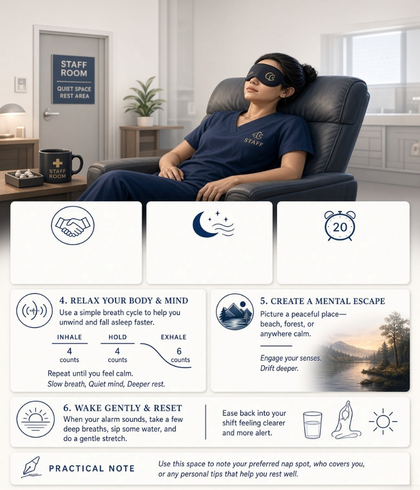
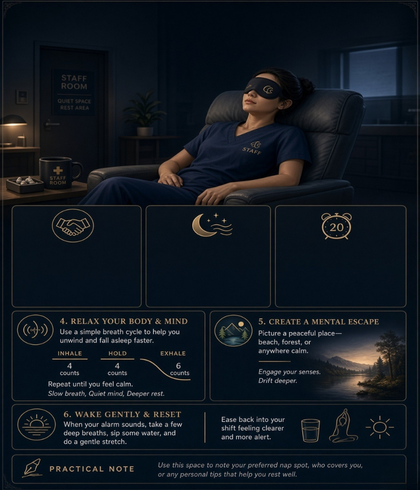
Set an alarm for 20 minutes. Aim for 10–20 minutes of sleep. Even lying still with your eyes closed helps if sleep doesn't come.
Settle your breathing. Breathe in for four counts, hold for four, breathe out for six. Repeat several times.
Picture somewhere calm. A beach, a forest, a familiar place. Notice the sounds and colours.
Wake up gently. Sit up, drink water, get some light, and stretch. Allow 10–15 minutes before any critical task, such as checking medication or performing a procedure.
Nap before you drive home. After a night shift, a short nap before getting behind the wheel can improve safety.
Good to know: If you use calming scents, keep them to your own space. Strong scents in shared areas can affect patients and colleagues with allergies or asthma; essential oils can also irritate skin.
What the studies cannot tell us
Many napping studies are small and conducted in sleep laboratories rather than on real wards.
Reviews of night-shift naps rate the evidence as low quality; the ideal nap length remains debated.
Naps reduce tiredness on the day. They do not replace sufficient sleep over time, nor do they correct rosters that leave too little recovery time.
When to get help
If you are exhausted most days, fall asleep without meaning to, snore heavily, or wake up unrefreshed no matter how long you sleep, speak with your GP. These can be signs of a sleep condition worth investigating.
If tiredness is wearing down your mood and things feel heavy, please reach out: Lifeline 13 11 14 (24/7), or 000 in an emergency.
Rest is not something you earn only at the end of the shift. It is part of how you keep doing the work you care about.
Rest is part of the work
On a long shift, rest is often the first thing to go. Four centuries before night rosters, people already knew what science now confirms: sleep holds everything else together.


"Sleep is that golden chain that ties health and our bodies together."
— Thomas Dekker, 1609
How rested are you, really?
A 20-minute reset helps on a hard shift. But if you are reaching for one every day, it is worth asking what your rest is telling you.
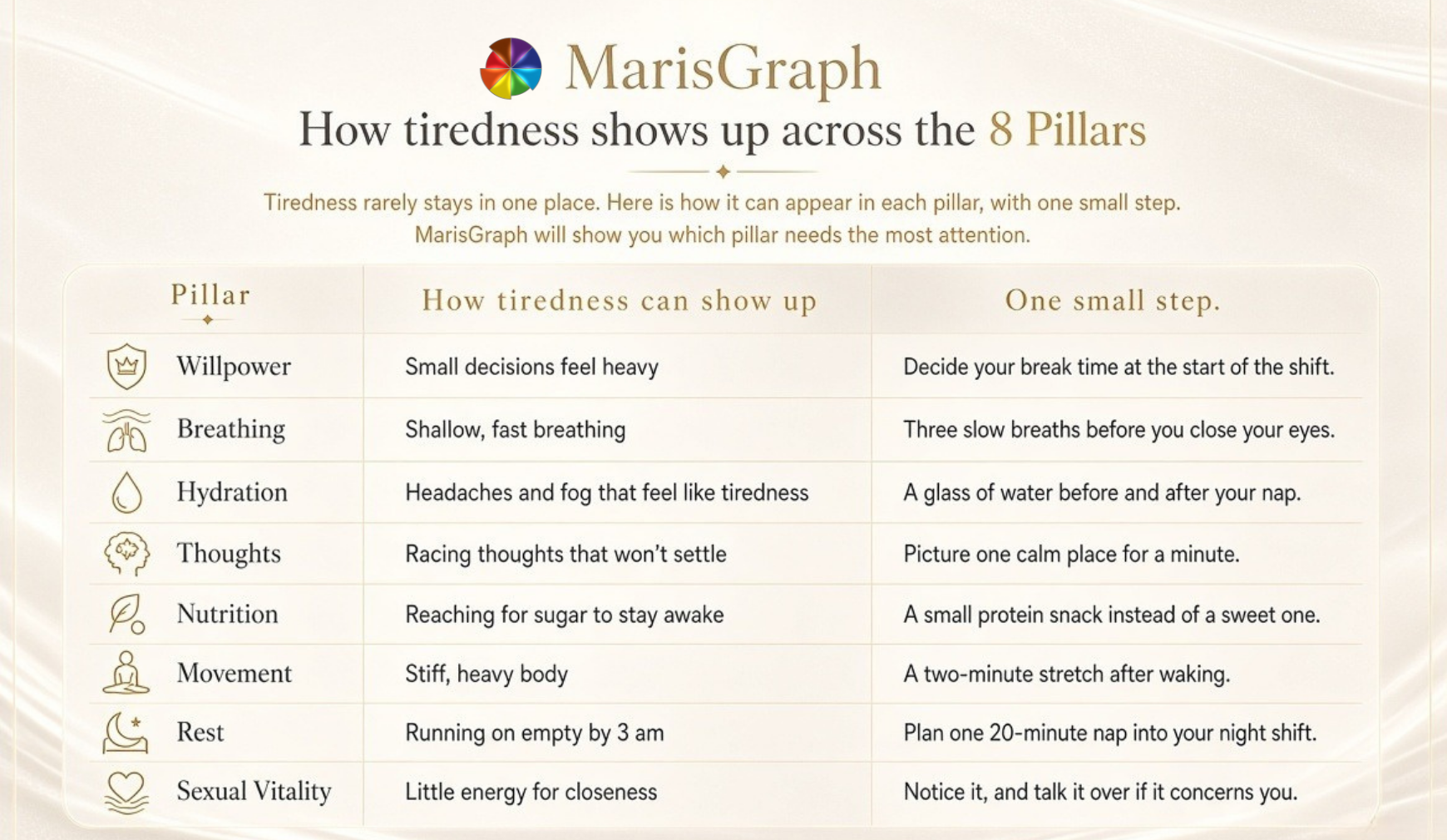
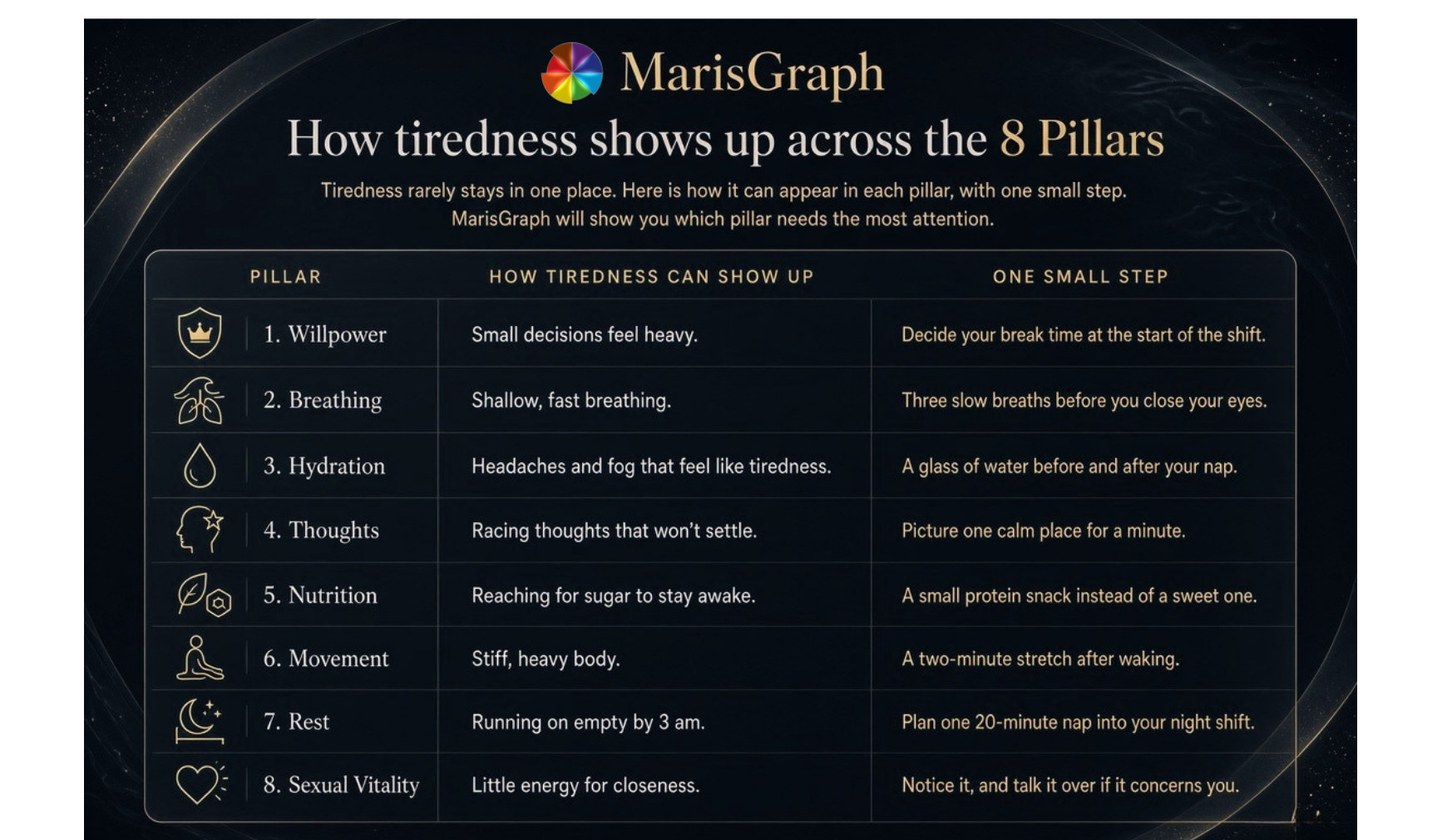
The MarisGraph Assessment maps your wellbeing across eight pillars, including Rest, Breathing, Hydration and Thoughts. You will see where you are strongest and which pillar is draining you most, so you know where one small change will count.
Built for healthcare professionals and shift workers
Your results are private to you
A tool for self-reflection, not a diagnosis
Key Takeaways
Keep it short. A 10- to 20-minute nap refreshes you without dropping into deep sleep, so you wake up alert, not groggy.
Time it with your shift. The low point in the early hours of a night shift, often between 2 and 5 am, is when a reset helps most.
Try a caffeine nap. Drink a coffee, then nap straight away; the caffeine takes effect as you wake.
Make the space work for you. An eye mask, earplugs, a set alarm and a quiet corner turn a break room into a reset room.
A nap supports sleep; it does not replace it. If you need one every shift, look at your overall rest, not just your breaks.
View Recommended Resources
Martin-Gill C, Barger LK, Moore CG, et al. Effects of napping during shift work on sleepiness and performance in emergency medical services personnel and similar shift workers: a systematic review and meta-analysis. Prehospital Emergency Care 2018. doi:10.1080/10903127.2017.1376136
Li H, et al. Napping on night shifts among nursing staff: a mixed-methods systematic review. Journal of Advanced Nursing 2019;75(2):291–312. doi:10.1111/jan.13859
Dutheil F, Danini B, Bagheri R, et al. Effects of a short daytime nap on cognitive performance: a systematic review and meta-analysis. International Journal of Environmental Research and Public Health 2021;18(19):10212. doi:10.3390/ijerph181910212
Leong RLF, et al. Influence of mid-afternoon nap duration and sleep parameters on memory encoding, mood, processing speed, and vigilance. Sleep 2023.
Patterson PD, Liszka MK, Mcilvaine QS, et al. Does the evidence support brief (≤ 30-min), moderate (31–60-min), or long-duration naps (61+ min) on the night shift? A systematic review. Sleep Medicine Reviews 2021;59:101509. doi:10.1016/j.smrv.2021.101509



 Nutrition







 Thoughts